
Most AI rollouts make results worse before anyone is willing to say so out loud. The businesses pulling ahead are not the ones with the biggest tool budgets. They are the ones who fixed their workflows before they touched a single AI product.
- 94-96% of organisations get worse results after adopting AI tools because they point AI at broken workflows instead of fixing the workflow first.
- Find your biggest operational constraint before touching any tool. AI amplifies whatever it lands on, including inefficiency.
- The businesses compounding real gains treat AI as a workflow redesign project, not a software purchase.
- Work is shifting from doing to framing and verifying. The people who thrive are the ones who learn to direct AI, not compete with it.
The Uncomfortable Truth About AI Adoption
There is a stat that should give every business leader pause. Across organisations that have adopted AI tools in the last two years, roughly 94 to 96 percent are getting worse results than they expected. Not neutral results. Worse. Slower decisions, more rework, confused teams, and a growing pile of software subscriptions that nobody uses consistently.
McKinsey has tracked this pattern across industries. BCG research puts the failure rate for large-scale AI integration projects above 70 percent. The numbers shift depending on how you define failure, but the direction is consistent.
The common explanation is that AI is overhyped. That is partially true, but it misses the real problem. The tools are not failing. The approach is.
Most organisations buy an AI tool and point it at whatever they were already doing. They automate the noise. They accelerate the confusion. They produce more output from a process that was already producing the wrong output. The AI does not cause the failure. It just makes the existing dysfunction faster and more expensive.
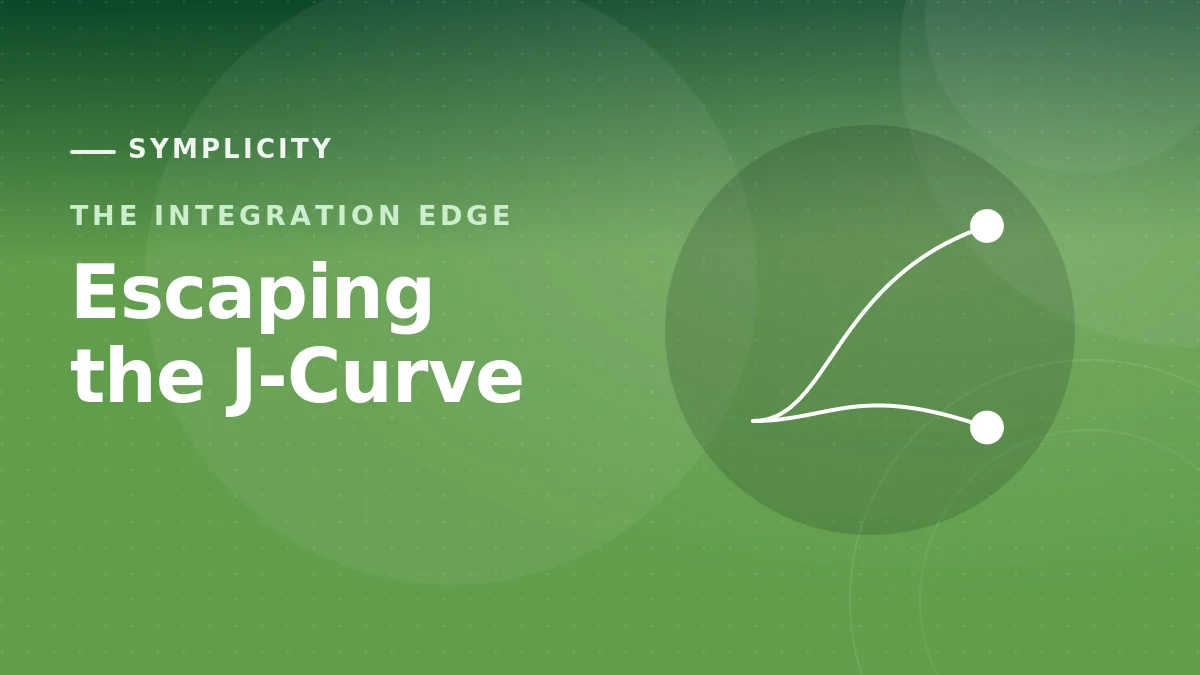
The J-Curve vs. the K-Curve
Think about what typically happens when an organisation adopts a new technology platform. Results dip before they improve. Teams are learning, processes are being adjusted, and things feel slower for a while. That is the J-curve. It is normal and manageable.
What is happening in AI adoption right now is different. Most organisations are getting the dip without the recovery. They ride the J down and stay there. The productivity gains they were promised never materialise because the underlying problem was never the tool. It was the workflow.
The 4 to 6 percent of organisations that are compounding real value are not riding the J-curve. They are on what you might call the K-curve. Instead of dipping and recovering, they take a short step back to redesign the workflow, then climb on a trajectory that keeps accelerating. The branches of the K represent compounding returns. Every improvement to the workflow makes the next AI-assisted task more effective.
The difference between the J and the K comes down to one question asked before any tool is purchased: where is the constraint?
Find the Constraint First
Every business has a bottleneck. One place where work slows down, quality drops, or decisions get delayed. That constraint limits everything upstream and downstream of it. You can optimise every other part of the operation and it will not matter much until you address the constraint.
The Theory of Constraints, developed by Eliyahu Goldratt, has been a fixture in manufacturing and operations management for decades. It applies directly to knowledge work and AI workflow integration. If you point AI at anything other than your primary constraint, you are making non-bottlenecks faster. That is waste. Sometimes it is expensive waste.
A contracting and cladding firm came to us with a clear ambition: grow revenue significantly over the next year. The instinct in their industry is to chase more leads and close more jobs. But when we mapped their operation, the constraint was not lead volume. It was estimating. Their estimating process was slow, inconsistent, and dependent on one or two senior people who were already stretched thin. They were turning down work and losing bids because estimates took too long to produce at the required quality.
We redesigned the estimating workflow first. Standardised the inputs, built structured templates, clarified the decision rules, and documented the tacit knowledge that lived only in the heads of the senior estimators. Then, and only then, did we integrate AI into the new workflow. The AI could now assist with takeoffs, flag inconsistencies, and generate first-draft estimates that a trained estimator could review and finalise in a fraction of the previous time.
The result: revenue roughly doubled in six months. Not because AI is magic. Because the constraint was identified, the workflow was fixed, and then AI was pointed at the redesigned process.
That sequence matters enormously. Most organisations do it in reverse.
Workflow Redesign Is Not a Technology Project
This is where a lot of leadership teams get stuck. They treat AI integration as an IT problem or a software rollout. They assign it to a technology committee, pick a tool, and roll it out to the team.
That approach fails for a predictable reason. Technology does not redesign workflows. People do.
The businesses that succeed at AI workflow integration treat it as an operational redesign project with technology as the enabler. They start by mapping the current state of the work, identifying where value is created and where it leaks, and building a new process design before anyone opens a browser tab to evaluate software.
Consider what this looks like in practice. A therapy clinic with three practitioners wanted to grow. The constraint was not therapist availability, at least not immediately. It was the administrative load that ate into clinical time and made onboarding new practitioners slow and inconsistent. Intake, scheduling, documentation, and billing were all managed through a mix of email, spreadsheets, and informal hand-offs.
The clinic redesigned those workflows first. They standardised intake processes, built clear protocols for onboarding new clinicians, and created documentation templates that reduced the cognitive load on practitioners. AI was then integrated into the documentation workflow specifically, helping practitioners draft session notes and follow-up materials faster. Within two years, the clinic had grown from 3 to 16 practitioners. The growth was not bottlenecked by the constraint that had previously capped them because that constraint had been removed.
The technology accelerated what the workflow redesign made possible.
Do It With Your People, Not To Them
There is a version of AI integration that happens behind closed doors. Leadership and a few consultants decide on the new tools and processes, then roll them out to the team. The announcement is framed as exciting and forward-looking. The actual experience for the people doing the work is confusing and demoralising.
This approach fails consistently and for reasons that should be obvious. The people doing the work have the most accurate picture of where the real problems are. They know which steps are actually necessary, which hand-offs break down, and where the informal workarounds live that do not appear in any process document. Cutting them out of the redesign process means missing the most important inputs.
It also creates resistance that kills adoption. If a team feels that AI is being done to them rather than with them, they will find ways to work around it. The tools will go unused, the new workflows will quietly revert to old patterns, and the organisation will have spent a significant budget to move backwards.
The K-curve organisations involve their people from the first conversation. Not as recipients of a change management communication, but as designers of the new workflow. They ask: where does your work slow down? What information do you wish you had? What do you spend time on that feels like it should be faster? Those questions surface the real constraints and generate the practical insights that make redesigns stick.
People also adapt more readily when they understand the direction of the shift. Work is moving away from raw doing and toward framing and verifying. The estimator who used to build every takeoff from scratch now frames the problem for the AI, reviews the output for quality, and applies the judgment that comes from years of experience. The role has not disappeared. It has moved up the value chain.
That is a much more useful and motivating framing than the typical message that AI will free people up for higher-value work, which usually lands as a polished way of saying that headcount is next. AI amplifies talent. It does not replace it.
The Economics Are Changing Under Everyone's Feet
Most business software has been sold on a per-seat model. You pay a fixed amount per user per month, and the cost scales with your headcount. AI is changing that.
The emerging model is per-token or per-use. You pay for what the AI actually processes and produces. This sounds like a technical pricing detail, but the strategic implications are significant.
Per-token economics mean that the cost of AI-assisted work scales with output, not with people. A five-person team with a well-designed workflow and AI integration can now produce at a scale that previously required a team three or four times larger. The economics of the business change in ways that create competitive separation between organisations that have done the workflow integration work and those that have not.
This also means that the productivity gains from AI workflow integration are not evenly distributed. Research on knowledge work suggests that well-implemented AI assistance can lift individual productivity by around 40 percent on relevant tasks. But that lift lands almost entirely on teams with clear workflows, clean inputs, and people who have learned to direct AI effectively. Teams with ambiguous processes and poorly defined outputs see little to no gain. Sometimes they see a decrease, because the AI produces confident-sounding wrong answers that then need to be caught and corrected.
The quality of your workflow determines how much of the available productivity lift you actually capture.
The Macro Picture Is Not Going Away
The IMF estimates that 60 percent of jobs in advanced economies will be materially changed by AI over the next decade. The World Economic Forum projects that roughly 92 million roles will be displaced while 170 million new ones are created. The net is positive, but the transition is not automatic or evenly distributed.
For SMB owners and leadership teams, the macro picture matters less than the specific question of what it means for your operation in the next 12 to 24 months. And the answer is that the organisations building durable competitive positions right now are the ones treating AI workflow integration as a strategic priority, not a line item in the IT budget.
This does not require a large technology investment. It requires clear thinking about constraints, honest engagement with the people doing the work, and the discipline to redesign the workflow before reaching for a tool.
A construction firm that worked through this process saw revenue grow from $42 million to $180 million over several years. The AI tools they used were not proprietary or especially sophisticated. What was different was that they had mapped their operations carefully, identified where the real leverage points were, and integrated technology into workflows that had been deliberately designed to use it well.
AI amplifies what it lands on. If it lands on a well-designed workflow built around your primary constraint, it amplifies value. If it lands on confusion and noise, it amplifies confusion and noise, faster.
What Separates the 4-6 Percent
The organisations on the K-curve share a few observable characteristics:
- They identified their primary constraint before evaluating any tools.
- They redesigned the workflow around that constraint with the people who do the work.
- They selected AI tools to fit the new workflow, not the other way around.
- They built in a review and verification step rather than treating AI output as final.
- They measured results against the constraint they were trying to relieve, not against tool adoption metrics.
None of these steps require a large budget or a technology background. They require operational clarity and the willingness to do the diagnostic work before jumping to solutions.
The per-seat software model rewarded the organisations that could deploy broadly and fast. The per-token AI model rewards the organisations that can deploy precisely and effectively. Precision comes from constraint identification and workflow design. That is the work most organisations are skipping.
Frequently asked questions
AI tools fail when they are pointed at broken or unclear workflows. The 4 to 6 percent of organisations compounding real gains are doing something different: they find the primary constraint first, redesign the workflow with the people who do the work, and then integrate AI into the new process. Work is shifting from raw doing toward framing and verifying, and the businesses building durable advantage are the ones treating AI workflow integration as an operational redesign project rather than a software purchase.
The single next step: before evaluating any AI tool, map one full workflow in your business and write down where it slows down most. That is your starting point.